The Classic
The original text
「味辛微寒。主中风寒热,心下逆气,惊喘,口干苦焦,不能息,腹中坚痛,产乳,金创。」
Pungent in flavor, slightly cold. It treats wind stroke with cold and heat, counterflow qi below the heart, fright wheezing, dry mouth and parched bitterness with inability to breathe, hard pain within the abdomen, childbirth and nursing, and wounds from metal.
RootBro's note — 'Great heat, great thirst, great sweating, a surging large pulse' — the four greats are the standard portrait of the gypsum pattern, corresponding to high fever with severe dehydration in modern medicine. Baihu Tang is the classical formulary's number-one formula for bringing down high fever.
PhD Insight
A systems-biology reading
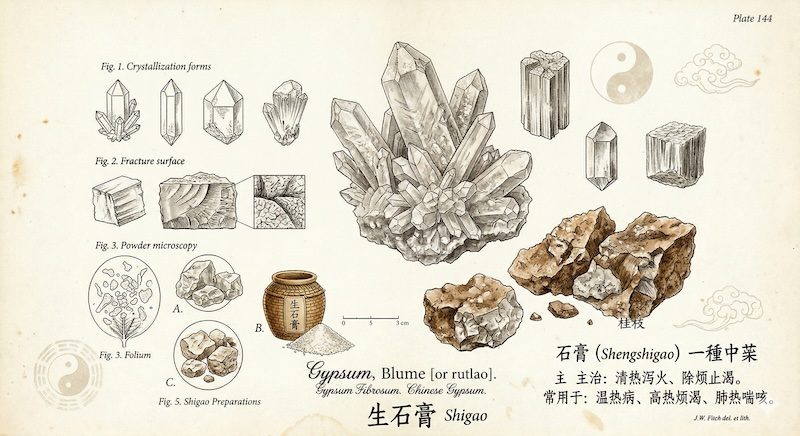
Gypsum's main constituent is calcium sulfate (CaSO₄·2H₂O). Ca²⁺ reduces fever by inhibiting prostaglandin synthesis in the temperature-regulating center, while replenishing the electrolytes lost to 'great sweating.'
CaSO₄·2H₂O · 含水硫酸钙
Ca²⁺ → inhibits hypothalamic PGE₂ synthesis → the temperature set-point drops → fever falls. SO₄²⁻ → mild catharsis → heat toxins are carried out. Together they form the complete heat-clearing mechanism for Yangming heat patterns.
The synergy of gypsum with zhimu (Baihu Tang): gypsum quickly lowers the temperature set-point, while the mangiferin in zhimu inhibits Na⁺-K⁺-ATPase and reduces heat production. One lowers the thermostat, the other cuts the heat at its source — a two-pronged attack.