Shennong Bencao Jing
010 / 030
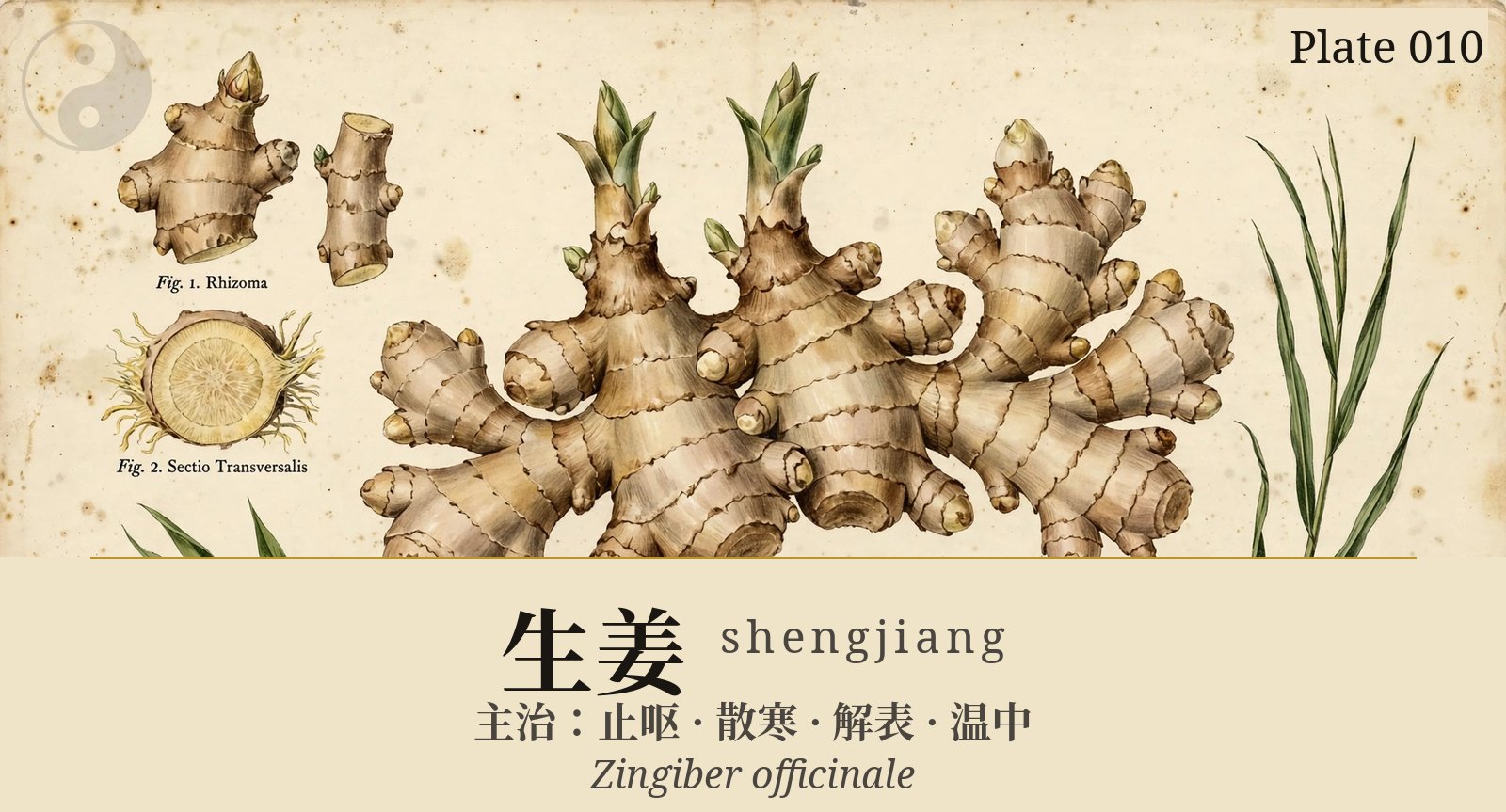
Shengjiang (Fresh Ginger) — classical plate
Zingiberis Rhizoma Recens · Fresh Ginger Plate 010
Zingiberis Rhizoma Recens
生姜 Shengjiang
Fresh Ginger
Rhizoma Zingiberis Recens
Nature & FlavorPungent; warm
ChannelsLung, Spleen, Stomach
Actions
Stops vomitingDisperses coldReleases the exteriorWarms the center
Six ChannelsAn assisting herb in Taiyang and Shaoyang patterns
The Classic The original text

「味辛温。主胸满咳逆上气,温中止血,出汗,逐风湿痹,肠澼,下利。生者尤良。」

Pungent in flavor, warm. It treats fullness in the chest with cough and upward-rushing qi, warms the center, stops bleeding, brings out sweat, drives out wind-damp blockage, intestinal afflux and diarrhea. The fresh one is especially good.

RootBro's note — 'The sage herb for stopping vomiting' is posterity's verdict on fresh ginger. In Xiao Chaihu Tang, ginger pairs with banxia to form a double antiemetic mechanism — one central, one peripheral — reinforcing each other.
PhD Insight A systems-biology reading
Key constituents gingerol and its heated product shogaol produce a double effect — antiemetic and pro-digestive — by antagonizing 5-HT₃ receptors and activating gastric motility.
Gingerol / Shogaol · 姜辣素 / 姜烯酚
5-HT₃ receptor antagonism → vagal afferent signaling suppressed → vomiting stops. TRPV1 activation → gastrointestinal motility ↑ → digestion promoted. Also inhibits prostaglandin synthesis → anti-inflammatory and analgesic.
Fresh ginger is banxia's natural antidote: gingerol dissolves the calcium oxalate needle crystals in banxia so they cannot stab the mucous membranes. Processing banxia by boiling it with ginger (jiang banxia) exploits exactly this chemical antagonism — the material basis of safety in classical pairing.
Logic Pairing Classical pairings
Xiao Chaihu Tang (Minor Bupleurum Decoction)Guizhi Tang (Cinnamon Twig Decoction)Xiao Banxia Tang (Minor Pinellia Decoction)Wuzhuyu Tang (Evodia Decoction)Shengjiang Xiexin Tang (Fresh Ginger Decoction to Drain the Epigastrium)
← Previous Dazao · 大枣

⚠️ Safety note: This page is study material on the Chinese medical classics, offered for cultural and educational understanding only. It is not a diagnosis, a prescription, or a promise of treatment. Herbs are medicine — use them only under the guidance of a licensed practitioner, and never compound or take them on your own.

HerbBlueMap HomePain Point FinderHerb Library中文原版 · Chinese Edition (tcmus.net)