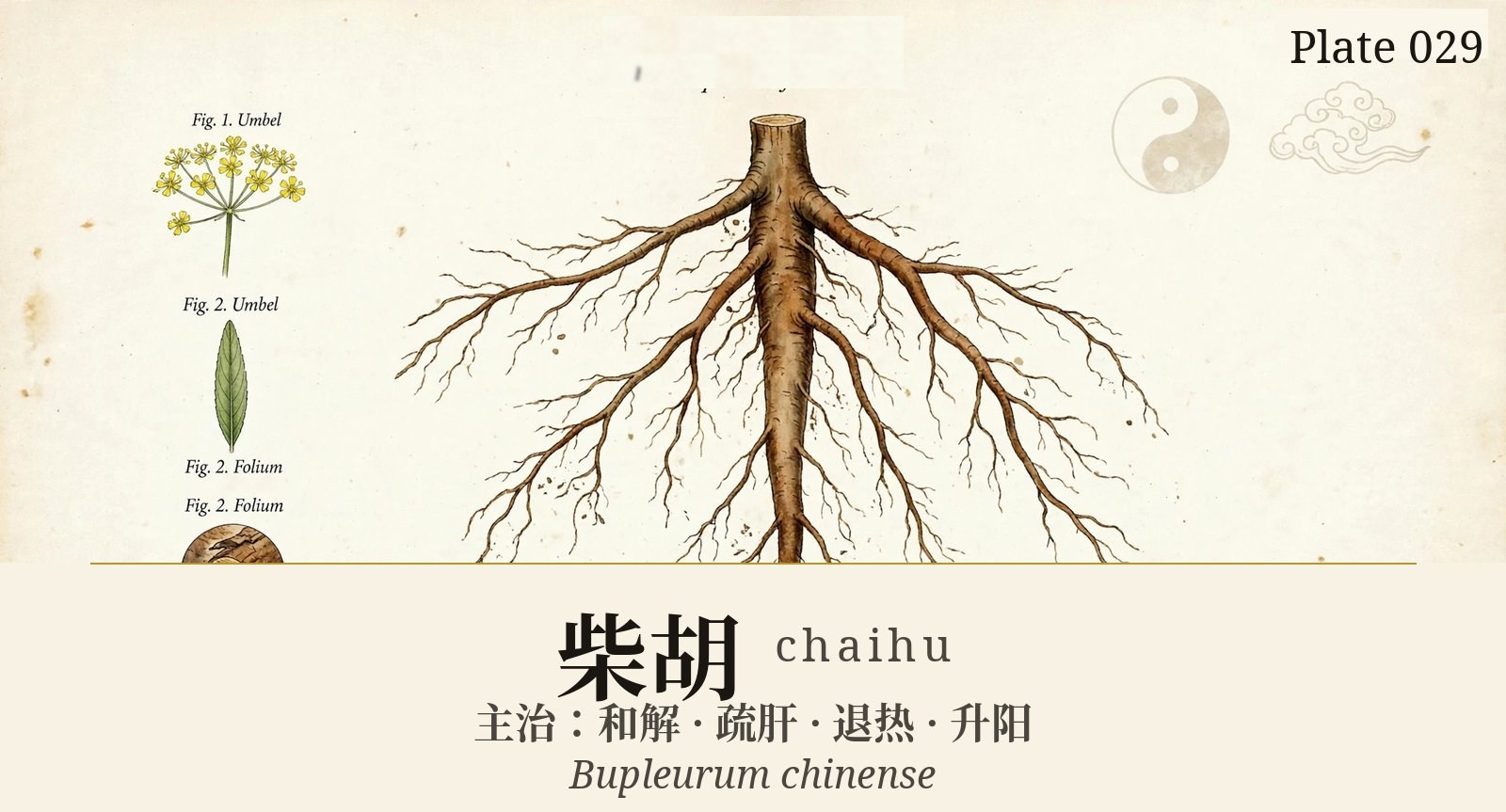
The ClassicThe original text
「味苦平。主心腹肠胃中结气,饮食积聚,寒热邪气,推陈致新。」
Bitter in flavor, neutral. It treats bound qi in the heart, abdomen and intestines, accumulations of food and drink, and cold-and-heat pathogens; it pushes out the stale and brings in the new.
RootBro's note — 'Harmonizing the Shaoyang' is chaihu's unique position: among the six channels, only Shaoyang disease is treated by harmonizing rather than by sweating, vomiting or purging. Chaihu opens the Shaoyang 'hinge,' so the pathogen can neither sink inward nor stay locked outside — the most diplomatically gifted herb in the classical formulary.
PhD InsightA systems-biology reading
Its key constituents, the saikosaponins, are potent anti-inflammatory and immunomodulatory agents. They reduce fever by regulating the HPA axis, and they protect liver cells at the same time.
Saikosaponin a/d · 柴胡皂苷a/d
Inhibits PGE₂ synthesis → fever falls (effective for alternating chills and fever). Rebalances Th1/Th2 → two-way immune regulation. Activates glucocorticoid receptors → anti-inflammatory, a hormone-like action without hormonal side effects.
An immunological reading of 'alternating chills and fever': in Shaoyang disease the fever is irregular, rising and falling — the immune system's response to the pathogen waxing and waning. Saikosaponins regulate the rhythm of that response until it stabilizes. That is the biological essence of 'harmonizing.'