Shennong Bencao Jing
003 / 030
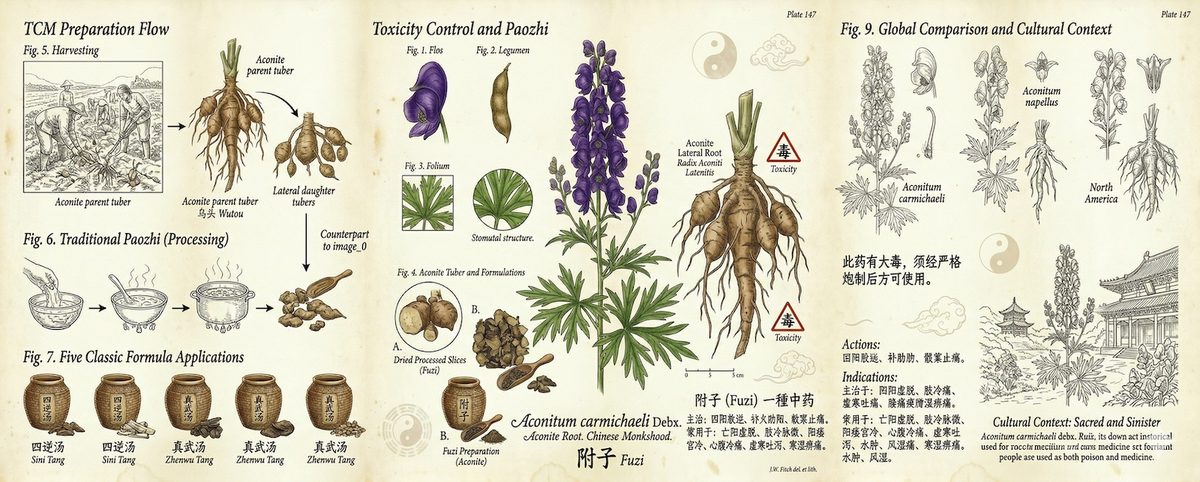
Fuzi (Aconite Root) — classical plate
Aconiti Radix
附子 Fuzi
Aconite Root
Radix Aconiti Lateralis Preparata
Nature & FlavorPungent, sweet; very hot; toxic
ChannelsHeart, Kidney, Spleen
Actions
Restores yangSupplements fireDisperses coldRelieves pain
Six ChannelsThe chief herb of Shaoyin disease
The Classic The original text

「味辛温。主风寒咳逆邪气,温中,金创,破癥坚积聚,血瘕,寒湿痿痹,拘挛膝痛,不能行步。」

Pungent in flavor, warm. It treats wind-cold with cough and counterflow pathogens, warms the center, wounds from metal, breaks up hard masses and accumulations, blood lumps, cold-damp withered blockage, cramping and knee pain with inability to walk.

RootBro's note — The fiercest yang-warming herb in the classical formulary — and the most misunderstood. 'Restore yang, rescue from collapse' corresponds to anti-shock treatment in modern medicine, with strict indications; used wrongly in a heat pattern it is extremely dangerous.
PhD Insight A systems-biology reading
Its main active constituent, aconitine, hydrolyzes during processing into benzoylaconine-type compounds, sharply reducing toxicity. Its cardiotonic action works by activating myocardial Na⁺ channels — similar to digitalis in effect, different in mechanism.
Benzoylmesaconine · 苯甲酰乌头原碱
Na⁺ channel activation → myocardial contractility ↑ (cardiotonic) + peripheral vascular tone ↑ (raises blood pressure). Indicated for the 'three lows' of Shaoyin cold transformation: low cardiac output, low blood pressure, low body temperature.
A modern reading of 'Shaoyin cold transformation': falling cardiac output starves the tissues of perfusion, temperature regulation fails, metabolic rate sinks. Fuzi's cardiotonic, pressure-raising action is a precise intervention aimed at exactly that state.
Logic Pairing Classical pairings
Si Ni Tang (Frigid Extremities Decoction)Zhen Wu Tang (True Warrior Decoction)Mahuang Fuzi Xixin Tang (Ephedra, Aconite & Asarum Decoction)Fuzi Tang (Aconite Decoction)Guizhi Fuzi Tang (Cinnamon Twig & Aconite Decoction)Bai Tong Tang (White Penetrating Decoction)
← Previous Mahuang · 麻黄

⚠️ Safety note: This page is study material on the Chinese medical classics, offered for cultural and educational understanding only. It is not a diagnosis, a prescription, or a promise of treatment. Herbs are medicine — use them only under the guidance of a licensed practitioner, and never compound or take them on your own.

HerbBlueMap HomePain Point FinderHerb Library中文原版 · Chinese Edition (tcmus.net)